For journalists
Balcony Solar Rules tracks plug-in solar laws in all 50 states and DC against official sources, with free data you can quote and link. Every figure below is computed from our data page; updated November 24, 2026.
Press kit
Status as of November 22, 2026. Everything in this kit is built from the same records as the rest of the site, researched against primary sources and published by the editor.
Key facts
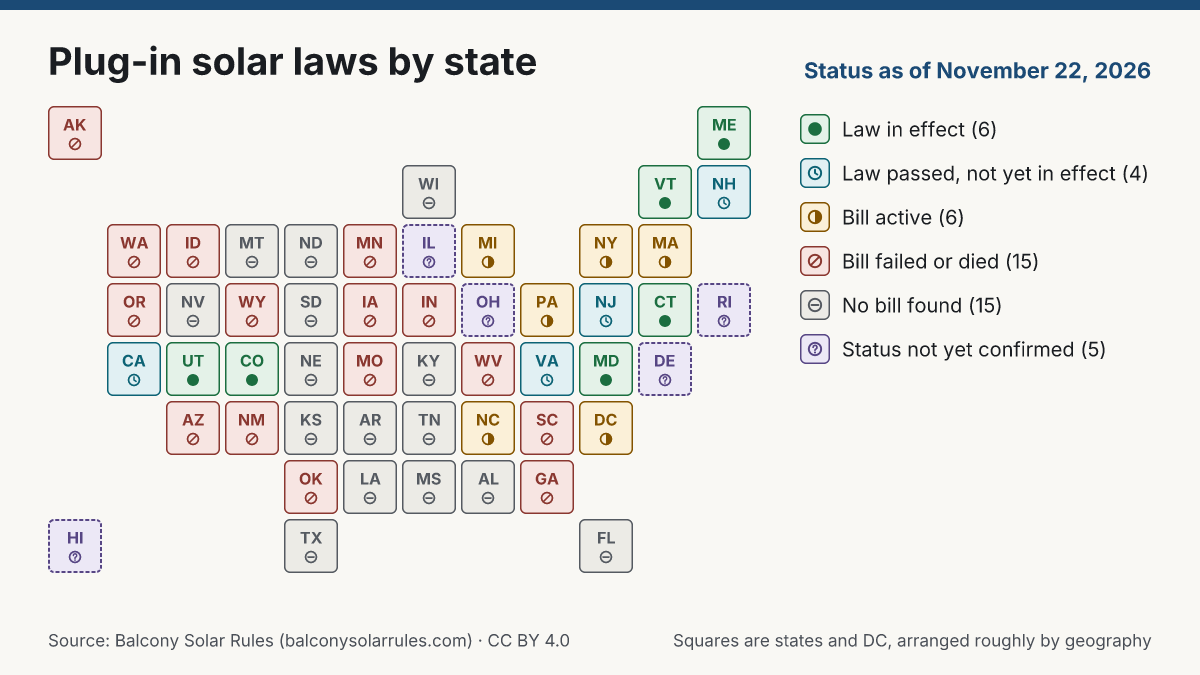
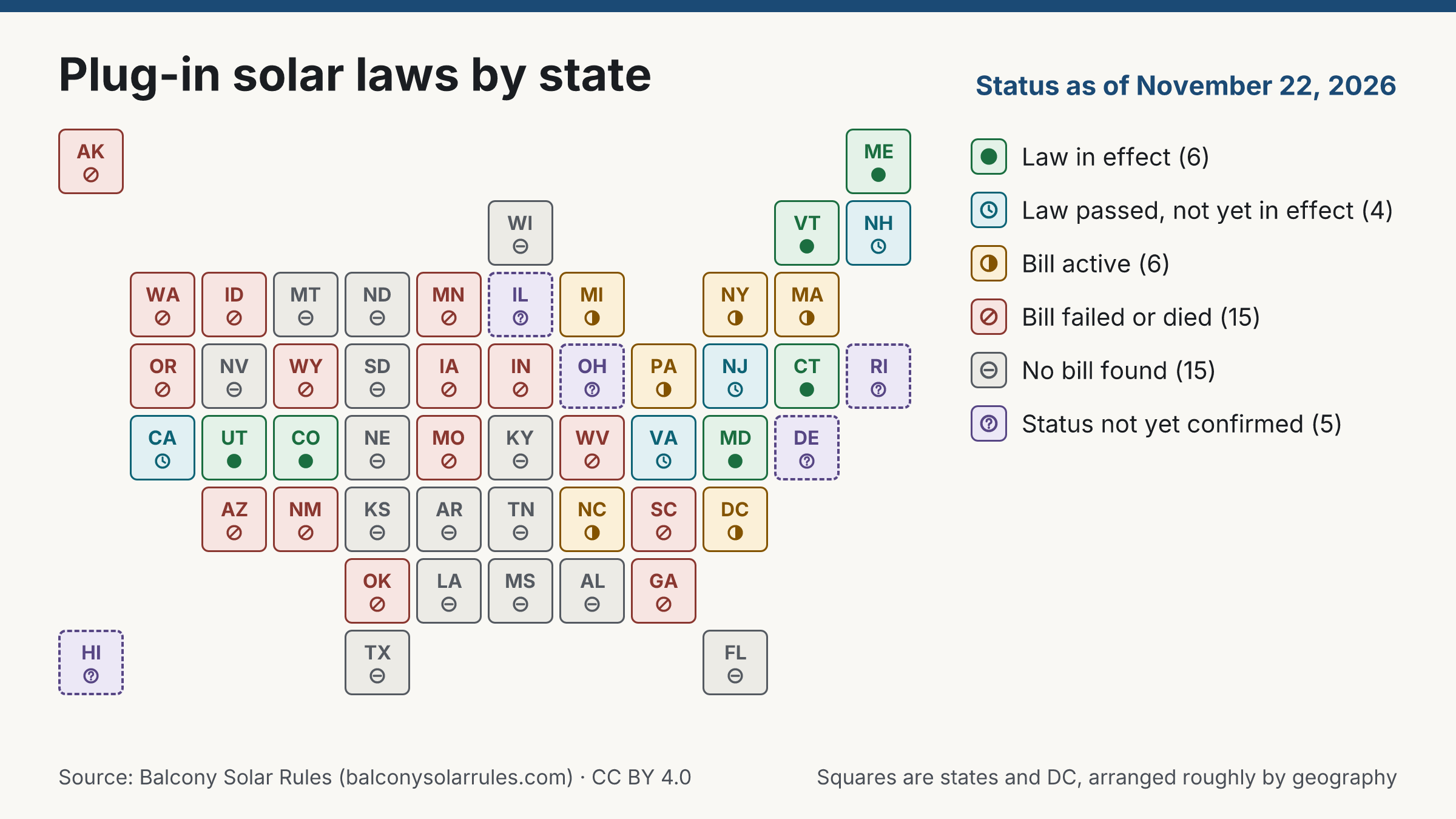
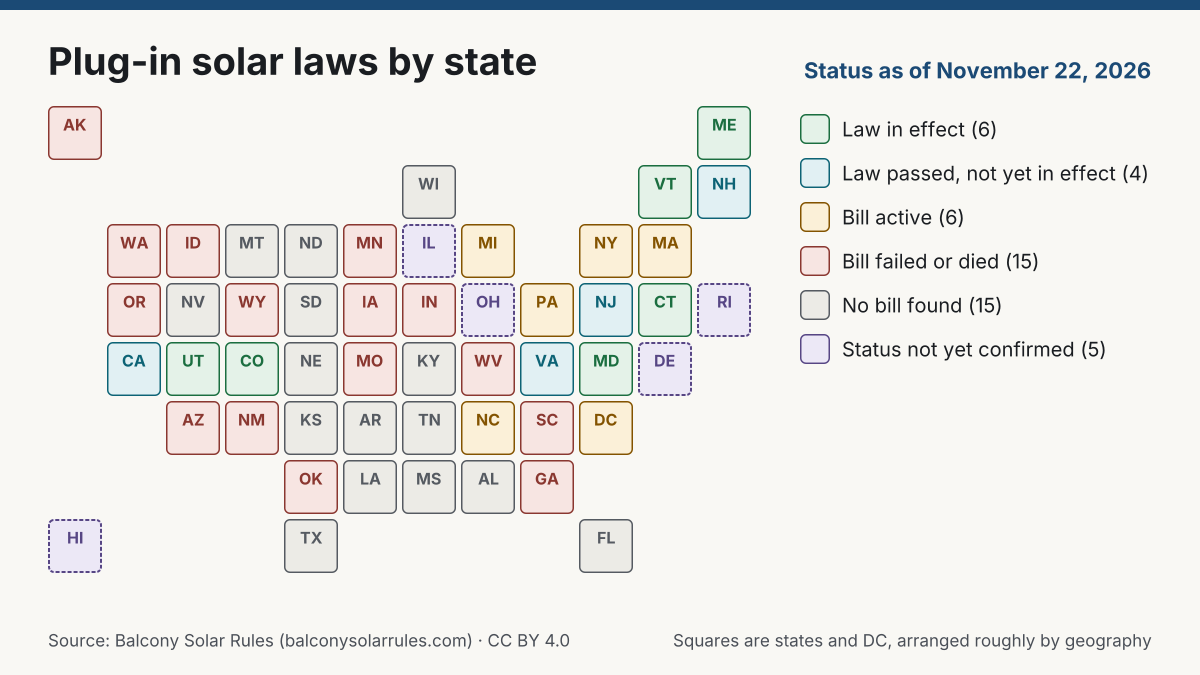
- 10 states have a plug-in solar law.
- 6 are in effect: Colorado, Connecticut, Maine, Maryland, Utah and Vermont.
- 4 are passed but not yet in effect: California (January 1, 2027), New Hampshire (January 1, 2027), Virginia (January 1, 2027) and New Jersey (March 1, 2027).
- 6 have an active bill: District of Columbia, Massachusetts, Michigan, New York, North Carolina and Pennsylvania.
- Data as of (the newest check of any state record; each state shows its own check date).
Cite this
Plain text:
Balcony Solar Rules, "Plug-in solar laws by state", data as of November 22, 2026. Edited by the Balcony Rules team. https://balconysolarrules.com/
APA style:
Balcony Solar Rules. (2026). Plug-in solar laws by state [Data set]. https://balconysolarrules.com/
Downloads
Status as of November 22, 2026. Free to use with credit (CC BY 4.0). Fields: state, postal code, status, bill, signed date, effective date, maximum output (W), utility notice, utility approval, tenant protection, HOA rule, certification requirement, source URL and the date we checked each state.
- Laws by state, CSV (one row per state and DC; Status as of November 22, 2026)
- Laws by state, JSON (same fields as the CSV; Status as of November 22, 2026)
- Map, PNG 1200 × 675 (for articles and social posts; Status as of November 22, 2026)
- Map, PNG 2400 × 1350 (high resolution; Status as of November 22, 2026)
- Map, SVG (scales to any size; Status as of November 22, 2026)
Embed the map
Paste this code into your page. The map fits the width of your column, keeps its height reserved so your page does not jump, loads only when a reader scrolls near it, and links each state to its page here. It runs no scripts.
Key facts and dates
- : 10 states have signed a plug-in solar law (California, Colorado, Connecticut, Maine, Maryland, New Hampshire, New Jersey, Utah, Vermont and Virginia); 6 are in effect. Details
- : California's law (SB 868) takes effect on January 1, 2027. Details
- : New Hampshire's law (SB 540-FN) takes effect on January 1, 2027. Details
- : Virginia's law (HB 395) takes effect on January 1, 2027. Details
- : New Jersey's law (S2368 / A4836) takes effect on March 1, 2027. Details
- : No complete certified kit is confirmed in any state yet: none of the 10 kits we track has a certificate covering the complete system. Details
Data pages: key findings and downloads · railing vs tilted panels, by state. Who we are: about Balcony Solar Rules.