US plug-in solar: state laws, kits and savings data (updated November 24, 2026)
Free data on plug-in (balcony) solar in all 50 states and DC, built from official legislature texts, certificates we have seen, NREL (National Laboratory of the Rockies) PVWatts v8, typical meteorological year weather and EIA electricity prices. Use it, quote it and link to it, with credit.
Page and files rebuilt November 24, 2026. Newest record checked November 22, 2026. Each state row carries its own check date.
Key findings
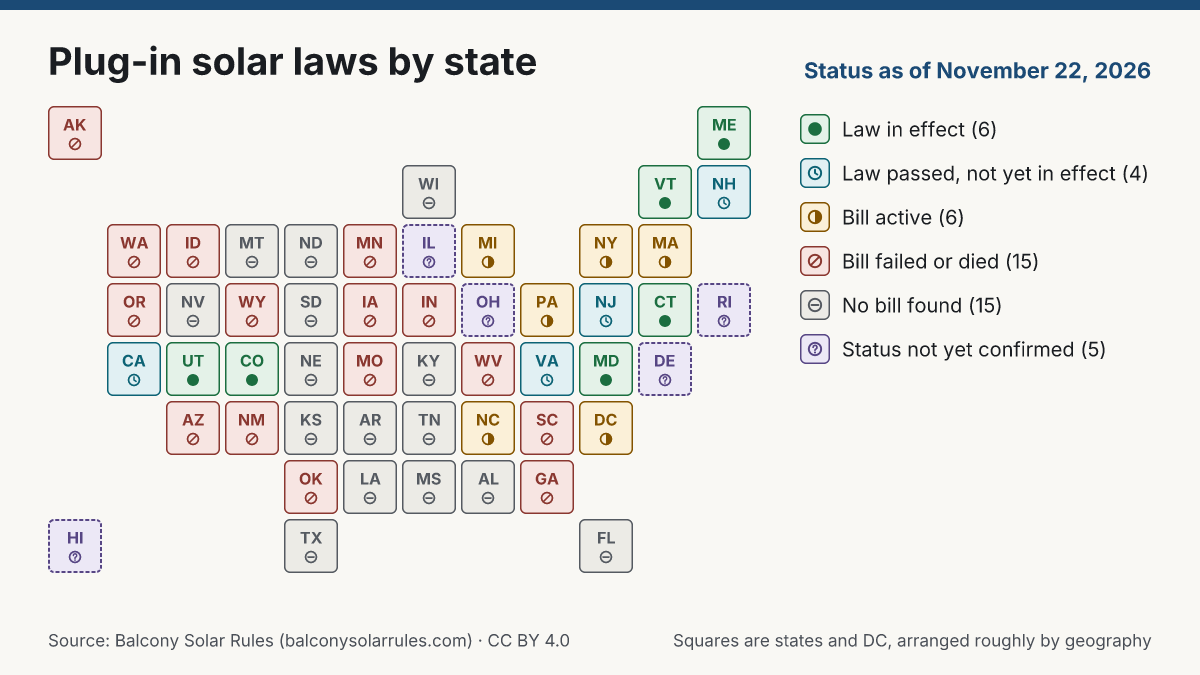
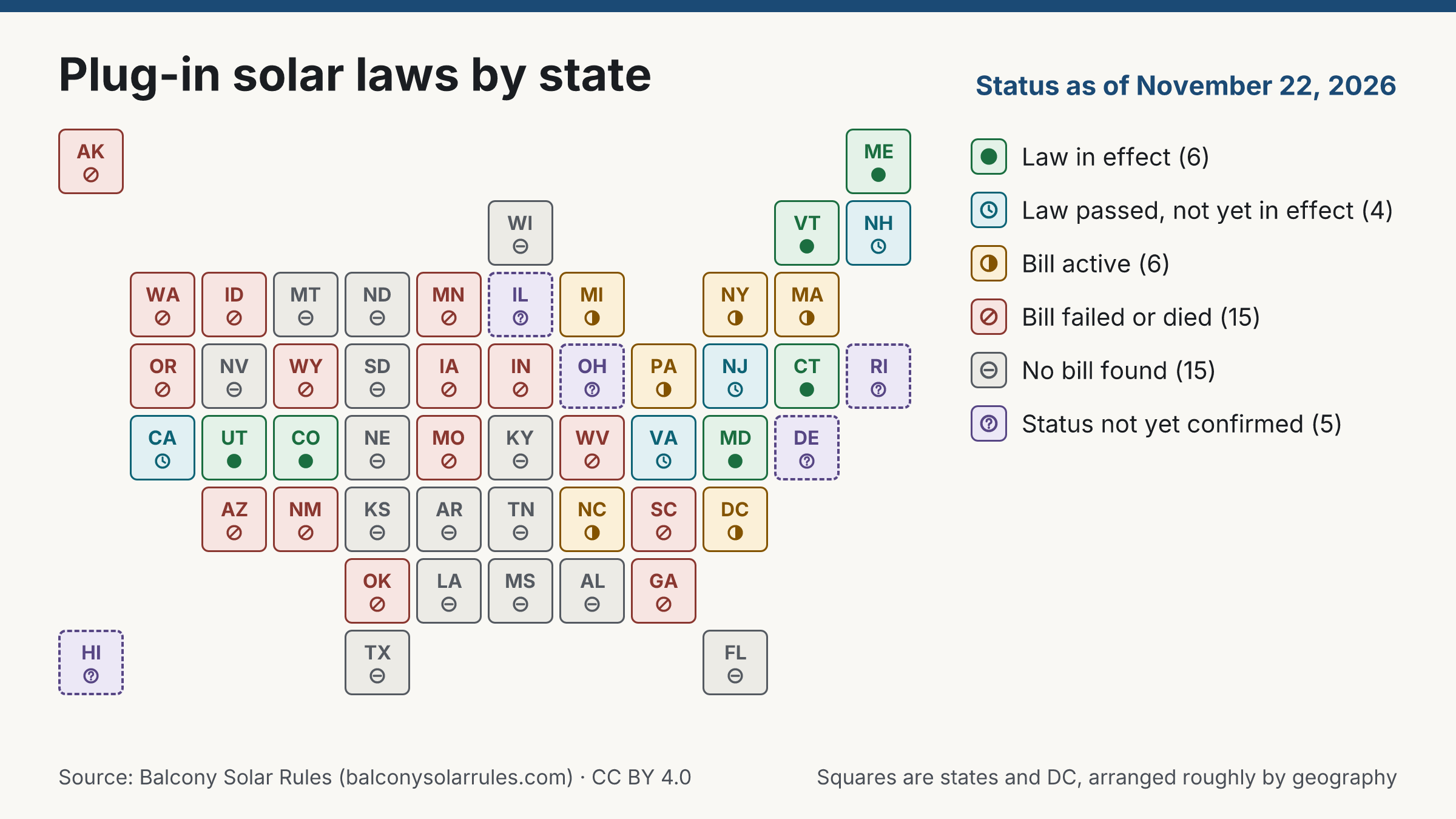
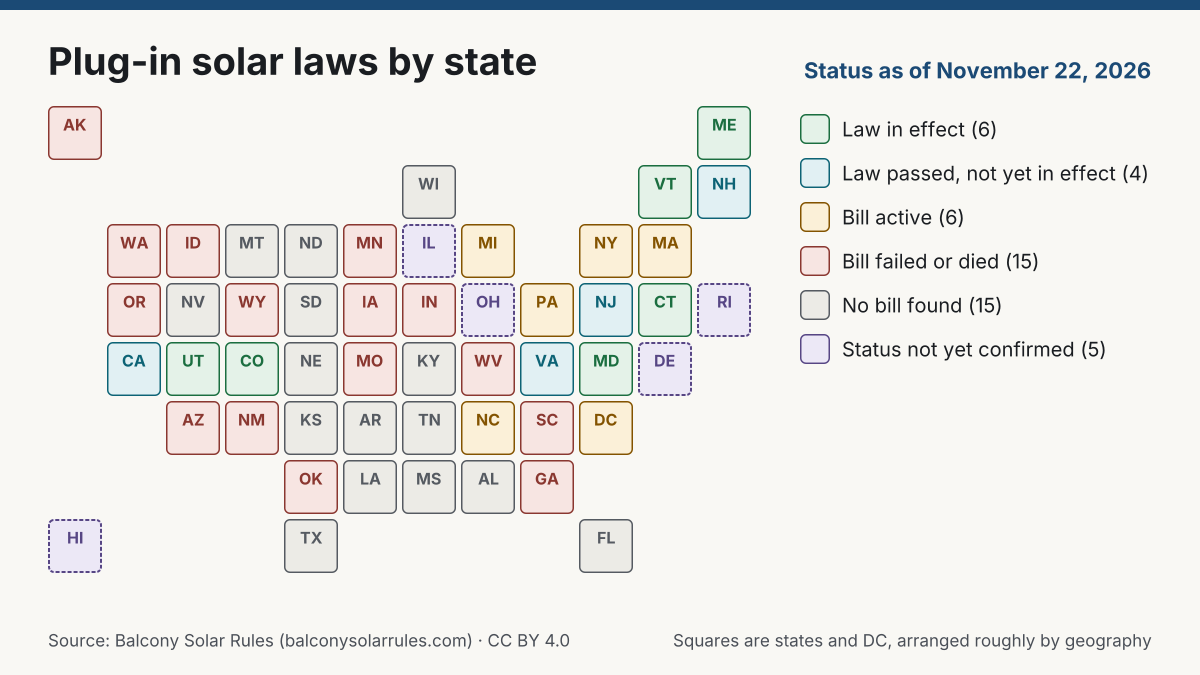
State laws. 10 states have signed a plug-in solar law: California, Colorado, Connecticut, Maine, Maryland, New Hampshire, New Jersey, Utah, Vermont and Virginia (6 in effect, 4 not yet in effect). How we verify state laws
New York. New York's A9111-C / S8512-C passed the Legislature on May 28, 2026 and is awaiting the governor's signature (not yet sent to the governor), so it is not law yet. New York record and sources
Certified kits. No complete kit is confirmed as certified for any state yet: none of the 10 kits we track has a certificate covering the complete system, so none of the 100 state-by-kit checks in our audit (10 law states × 10 kits) is "Compatible". How we judge kits
Payback. For an 800 W kit costing $1,099 (EcoFlow STREAM Microinverter + 2 x 400W Rigid Solar Panels) with 69% of its output used at home, payback in the 10 states with a plug-in law ranges from 3.8 years (California) to 10.1 years (Utah) with tilted panels, and from 6.2 years (California) to 15.1 years (Utah) on a balcony railing. How we estimate savings
Railing vs tilted. Vertical railing panels produce 61–77% of tilted output in the 10 plug-in-law states, and 43–79% across all 50 states and DC. How we model solar output
California. California's plug-in solar law (SB 868) takes effect on January 1, 2027, and its residential electricity price (32.34¢ per kWh) is the 2nd highest of the 50 states and DC. Price source and method
Kit audit: labels by count
Every state with a plug-in law (10) checked against every kit we track (10), with the same labels as the rest of the site.
Number of state-by-kit checks with each label
Label
Checks
Likely compatible: confirm with seller
6
Component certificate only: check with seller
4
Listing claimed, no certificate seen
48
UL 3700 claimed, no certificate seen
8
Not certified
8
No certification evidence found
26
Total
100
UL 3700 status of the 10 kits: 1 certified (certificate seen), 2 claimed by the maker, 2 not certified, 5 unknown. A certificate can cover one component or the complete system; 0 kits have one for the complete system.
Downloads
Both files are produced from our data each time the site is built, so they always match the pages. Licensed CC BY 4.0: you may reuse them, including commercially, with the credit "Source: Balcony Solar Rules (balconysolarrules.com)".
US plug-in solar: state laws, prices and savings
One row per state and DC: plug-in solar law status, bill, effective date, size limit, utility notice, renter and HOA rules, certification required, EIA residential electricity price, NREL PVWatts solar output for tilted (20°) and vertical railing (90°) panels, and yearly savings and payback for a reference kit at the typical share used at home.
US plug-in solar: kit certification audit by state
One row per state with a plug-in solar law and per kit we track: the certification the law asks for, the kit’s stated output, our verdict label and what it means, the certificate or claim the verdict rests on, and caveats.
The press kit files and the map are licensed CC BY 4.0: free to reuse with the credit "Source: Balcony Solar Rules (balconysolarrules.com)".
Notes: values the data files hold as "unknown" or "not_applicable" stay that way in the CSV. Savings use the EIA residential price for September 2025 – August 2026, the state capital's solar output, and assume exported power earns nothing. Railing means panels hung vertically (90°) facing south.
Savings by state
What our reference kit, the EcoFlow STREAM Microinverter + 2 x 400W Rigid Solar Panels (800 W of panels, listed at $1,099 on November 10, 2026), could save in a year in each state, with 69% of its power used at home, and how long it takes to pay for itself. 51 states (counting DC) have both a price and a solar figure, with railing figures for all of them.
Yearly savings and payback by state for a 800 W kit costing $1,099, 69% used at home
Estimates for information, not financial advice. Your own price per kWh, your balcony's direction and shade, and the kit you buy change the result: try the calculator with your numbers.
How we calculate
Yearly kWh = panel watts ÷ 1,000 × the state's yearly output per kW of panels. Yearly savings = yearly kWh × share used at home (69%) × the state's price. Payback = kit price ÷ yearly savings.
Prices: U.S. EIA, Form EIA-861M: Sales and revenue data by state, monthly (sales_revenue.xlsx), residential average for September 2025 – August 2026. Solar output: NREL (National Laboratory of the Rockies) PVWatts v8, typical meteorological year weather, run for each state capital with 14% system losses, panels facing south at 20° ("tilted") and at 90° ("railing"). Share used at home: 69%, from HTW Berlin's Stecker-Solar-Simulator for an 800 W system with no battery in a home using 3,000 kWh a year (details).
We assume no payment for power sent to the grid, no incentives and no price changes. Where a figure is missing, we show no estimate rather than guess.
Cite this data
Balcony Solar Rules. (2026). US plug-in solar: state laws, kits and savings data (updated November 24, 2026) [Data set]. https://balconysolarrules.com/data/. Licensed under CC BY 4.0.
Short credit: Source: Balcony Solar Rules (balconysolarrules.com), with a link to this page.
Method
How we verify: primary sources only, "unknown" when we cannot confirm a fact.